


The Best Paper Award of the 7th International Conference on Artificial Intelligence in HCI
has been conferred to
Md Shajalal, Md Mahedi Hasan Riday (University of Siegen, Germany), Sima Amirkhani and Gunnar Stevens (University of Siegen / Bonn-Reihn-Siegn University of Applied Sciences, Germany)
for the paper entitled
"Human-Centered Explanations for Audio Deepfakes:
Making Machine Reasoning Human-Perceptible Through Voice Traits"

Md Shajalal
(presenter)
Best Paper Award for the 7th International Conference on Artificial Intelligence in HCI, in the context of HCI International 2026, Montreal, Canada, 26 - 31 July 2026
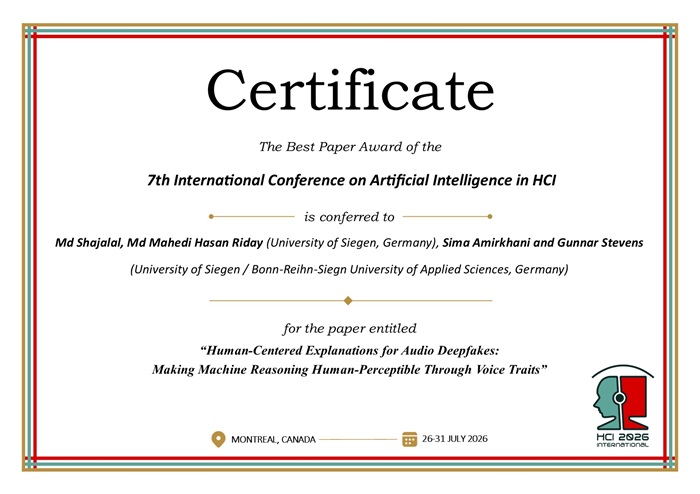
Certificate for Best Paper Award of the 7th International Conference on Artificial Intelligence in HCI presented in the context of HCI International 2026, Montreal, Canada, 26 - 31 July 2026
Paper Abstract
Advances in Generative Artificial Intelligence (GenAI) have made it increasingly easy to generate synthetic voices that closely resemble human speech, raising serious concerns for security, privacy, and trust in digital communication. While existing synthetic voice detection methods achieve strong technical performance, they typically rely on spectrogram-based or imperceptible acoustic features that offer limited interpretability and are difficult for non-expert users to understand. This paper presents a human-centered explainable framework for synthetic voice detection that explicitly connects low-level acoustic features to perceptible voice traits that listeners naturally use when judging authenticity. We systematically map classical acoustic features to six perceptual traits—voice tone, speech melody, emotionality, pause and conversational flow, breathing, and acoustics and spatial sounds. Building on this mapping, we introduce an explainable detection pipeline that can provide trait-level explanations for the prediction and translates them into concise, trait and language-based explanations aligned with human auditory perception. Experiments on the ASVspoof 2019 dataset demonstrate that the proposed approach preserves competitive detection performance while enabling human-centered, transparent and actionable explanations. In addition, we conduct a human-centered user study to investigate how trait-grounded explanations support user understanding, trust, and decision-making when assessing voice authenticity. The results show that trait-level explanations are perceived as understandable, trustworthy, and cognitively manageable, supporting user sense-making and confidence in model decisions. Grounding explainability in perceptible voice traits advances human-centered explainable AI for audio deepfake detection and enables more transparent and trustworthy AI interaction.
The full paper is available through SpringerLink, provided that you have proper access rights.