


The Best Paper Award of the 14th International Conference on Culture and Computing
has been conferred to
Emma Murrugarra, Mohith Oduru Ramesh, Burcak Ozludil Altin, Louis I. Hamilton
and Margarita Vinnikov
(New Jersey Institute of Technology, USA)
for the paper entitled
"Impact of Virtual Reality on Perception of Sacred Spaces: Case Study of Grotta Pinta Madonna"

Margarita Vinnikov
(presenter)
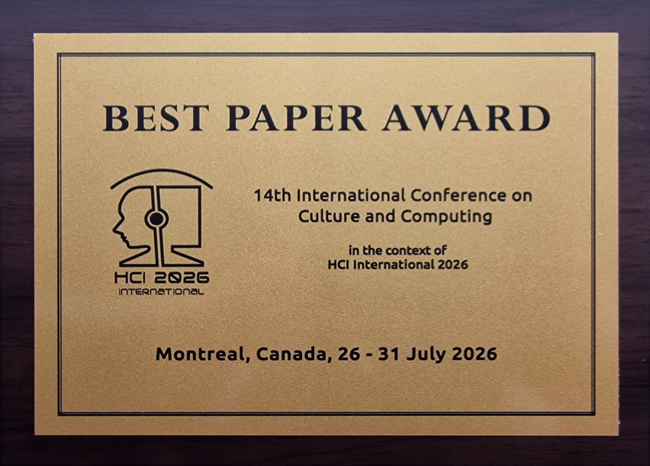
Best Paper Award for the 14th International Conference on Culture and Computing, in the context of HCI International 2026, Montreal, Canada, 26 - 31 July 2026
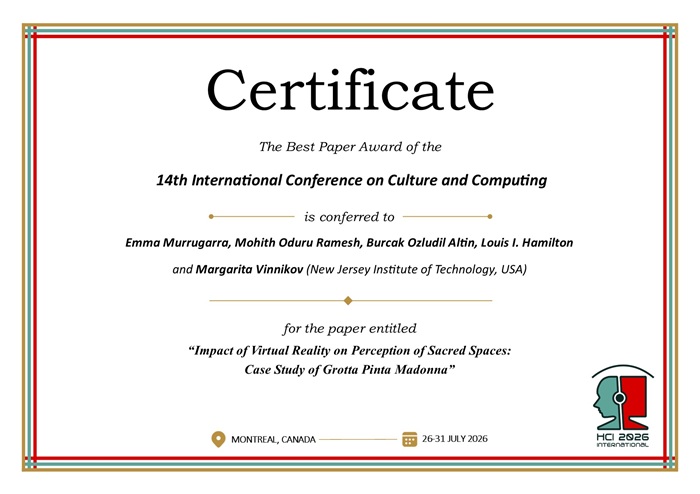
Certificate for Best Paper Award of the 14th International Conference on Culture and Computing presented in the context of HCI International 2026, Montreal, Canada, 26 - 31 July 2026
Paper Abstract
Virtual Reality (VR) allows us to observe hidden histories and investigate how people engage with historic informal sacred spaces. Examining the eye-tracking and location-tracking data from the “restored” Grotta Pinta Madonna, an historic shrine in Rome, this paper analyzes how participants attended to features within the virtual environment, such as time spent gazing at, or proximity to, religious iconography. Fifty-four participants freely explored a virtual scene of the shrine, experiencing either the pre-reconstruction (n=28) or post-reconstruction (n=26) version of the scene. Results indicate that gaze patterns and movement through the space varied by reconstruction condition. Moreover, participants’ attention to religious iconography or spatial features predicted their subjective perception of the virtual environment. These findings demonstrate the value of VR as a tool for examining engagement with reconstructed devotional spaces and suggest avenues for integrating behavioral measures into urban planning, digital heritage, and preservation efforts.
The full paper is available through SpringerLink, provided that you have proper access rights.