


The Best Paper Award of the 18th International Conference on Cross-Cultural Design
has been conferred to
Yibo Zhang, (Yonsei University, Korea), Yingjie Li, (Hebei University of Media and Communications, P.R. China), Xiaoyu Ren, (Tianjin University, P.R. China)
for the paper entitled
"Co-Designing AI-thenticity in Cross-Cultural Design: Authenticity Judgments and Trust in AI-Generated Cultural Symbols"

Yibo Zhang
(presenter)

Best Paper Award for the 18th International Conference on Cross-Cultural Design, in the context of HCI International 2026, Montreal, Canada, 26 - 31 July 2026
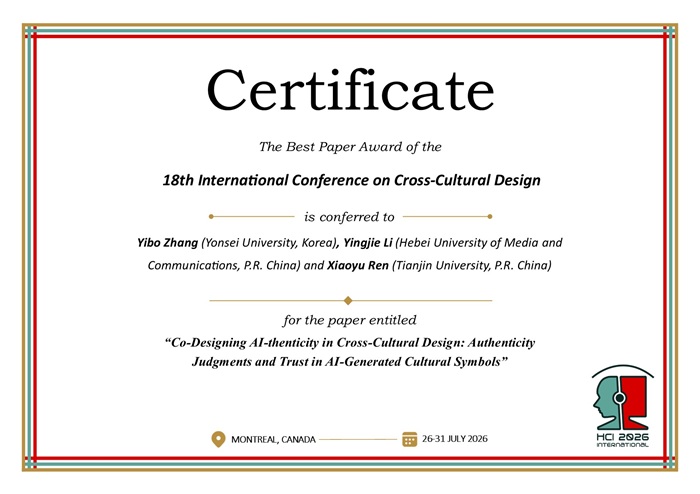
Certificate for Best Paper Award of the 18th International Conference on Cross-Cultural Design presented in the context of HCI International 2026, Montreal, Canada, 26 - 31 July 2026
Paper Abstract
Generative AI is increasingly used to create cultural symbols for heritage, tourism, and design, yet how such outputs are perceived as “authentic” and trustworthy across cultures remains under-explored. We present a co-designed investigation of AI-thenticity across China, South Korea, and the United States. Working with cultural practitioners in each region, we identified three design interventions intended to preserve authenticity and trust in AI-generated cultural symbols: (1) AI source disclosure, (2) culture-aware localization of generative outputs, and (3) human-in-the-loop revision by local experts. These interventions were implemented in an experimental platform and examined through a 45-participant pilot study (15 per region) using a factorial design. Participants evaluated AI-generated and human-designed symbols under varying conditions of disclosure, localization, and expert revision. Results show that AI-generated symbols, while often visually appealing, were rated significantly lower in perceived authenticity and trust than human-created symbols, particularly by participants highly familiar with the culture. However, culture-aware localization and expert revision substantially increased authenticity and trust ratings, in some cases narrowing the gap with human designs. Notably, disclosure effects varied cross-culturally: a simple “AI-generated” label reduced trust in the Chinese and Korean samples but had little impact among U.S. participants. We discuss implications for culturally sensitive transparency, human–AI collaboration, and data governance, offering actionable design guidelines for deploying generative AI in cultural contexts.
The full paper is available through SpringerLink, provided that you have proper access rights.