


The Best Paper Award of the 15th International Conference on Design, User Experience, and Usability
has been conferred to
Eric Brangier and Sarah Zahi
(Université de Lorraine, France)
for the paper entitled
"Designing the Right to Resist. Beyond Ethical Design Guidelines:
Experimental Insights and Implications for Education and Regulation"

Eric Brangier
(presenter)
Best Paper Award for the 15th International Conference on Design, User Experience, and Usability, in the context of HCI International 2026, Montreal, Canada, 26 - 31 July 2026
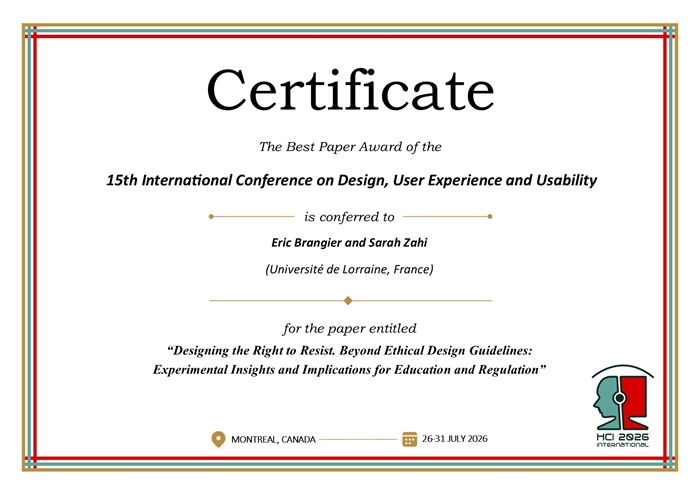
Certificate for Best Paper Award of the 15th International Conference on Design, User Experience, and Usability presented in the context of HCI International 2026, Montreal, Canada, 26 - 31 July 2026
Paper Abstract
This study proposes and empirically validates a criteria-based ethical evaluation grid for interface design based on: confidentiality, transparency, honesty, security, neutrality, loyalty (fair processing), and equity/non-discrimination. To assess the relevance power of the grid, an experimental study was conducted with 12 UX designers who evaluated 20 interface mock-ups. Participants identified ethical criteria violations based on structured guidelines. Results reveal moderate overall agreement and substantial variability across criteria (Cohen’s kappa = 0.46). Technical and regulatory criteria (e.g., security, neutrality) were identified more reliably, whereas relational and normative criteria (e.g., honesty, loyalty, privacy) showed confusion. These patterns reflect not a lack of expertise, but the inherent entanglement and interpretative nature of ethical judgment in HCI. Transparency emerged as a central heuristic, frequently conflated with other ethical dimensions. Beyond its methodological contributions, this study underscores the need for complementary educational and legislative measures to strengthen individuals’ fundamental right to resist undue interface influence. Ethics in HCI must be supported by training that strengthens users’ and designers’ critical capacities, as well as regulatory frameworks that promote transparency, accountability, and protection against manipulative practices. Ethical evaluation is thus framed as an ongoing, situated, and collective process involving design, education, and governance.
The full paper is available through SpringerLink, provided that you have proper access rights.