


The Best Paper Award of the 8th International Conference on HCI for Cybersecurity, Privacy and Trust
has been conferred to
Arwa Binsedeeq, Steven Furnell, Xavier Carpent and Nicholas Gervassis
(University of Nottingham, United Kingdom)
for the paper entitled
"Accessible by Design? How Cybersecurity Safeguards Support or Exclude Disabled Users"

Steven Furnell
(presenter)
Best Paper Award for the 8th International Conference on HCI for Cybersecurity, Privacy and Trust, in the context of HCI International 2026, Montreal, Canada, 26 - 31 July 2026
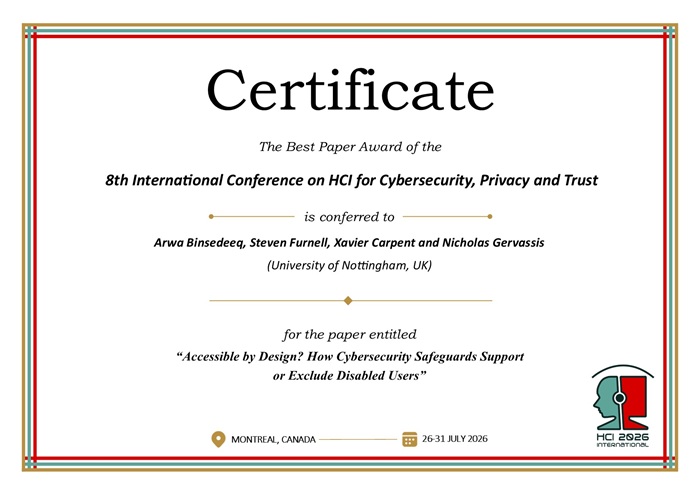
Certificate for Best Paper Award of the 8th International Conference on HCI for Cybersecurity, Privacy and Trust presented in the context of HCI International 2026, Montreal, Canada, 26 - 31 July 2026
Paper Abstract
Maintaining cybersecurity and having the ability to make use of associated controls is essential for all users of digital technologies. Unfortunately, the way in which such controls are designed, implemented and delivered in practice can pose potential challenges for users with disabilities. This study examines the usability and accessibility of common cybersecurity mechanisms (on-device settings, two-factor authentication, CAPTCHAs, and cookie consent interfaces). Observational trials were conducted with 17 participants from various disability groups, plus a non-disabled control group. The findings reveal accessibility barriers that disproportionately affect individuals with visual, cognitive, and upper-body mobility impairments. These include incompatibilities with screen readers, physically demanding navigation, inconsistent design elements and language use, and a lack of alternative verification methods and pathways. The results collectively highlight the need for greater attention towards the accessibility of cybersecurity and privacy controls, to help ensure equitable protection for all users.
The full paper is available through SpringerLink, provided that you have proper access rights.