


The Best Paper Award of the Human Interface and the Management of Information Thematic Area
has been conferred to
Atsuro Kimoto (Doshisha University, Japan), Masaaki Okabe (Nagoya University / Doshisha University, Japan), Kazuki Yokoishi and Hiroshi Yadohisa (Doshisha University, Japan)
for the paper entitled
"Mining Generative AI Logs to Understand Learning Experiences"
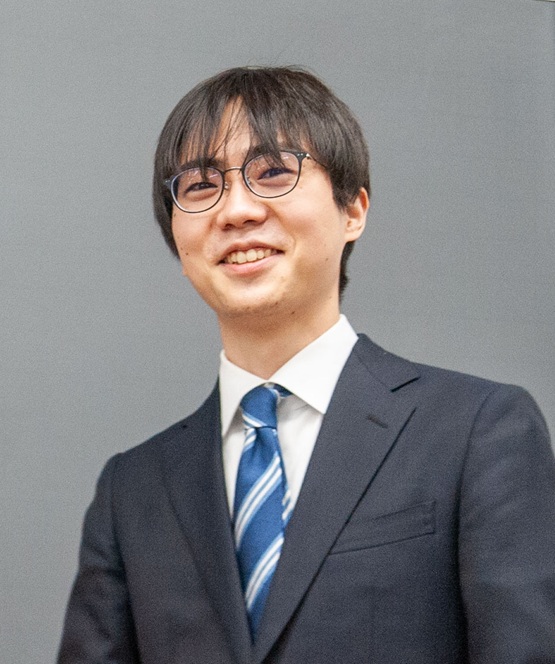
Atsuro Kimoto
(presenter)
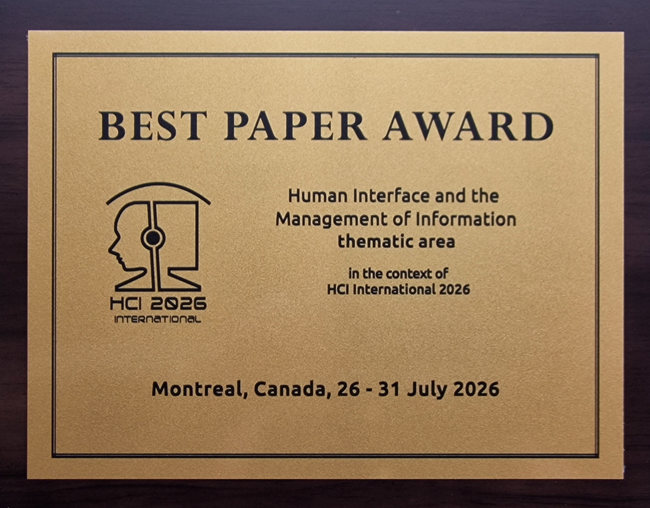
Best Paper Award for the Human Interface and the Management of Information Thematic Area, in the context of HCI International 2026, Montreal, Canada, 26 - 31 July 2026
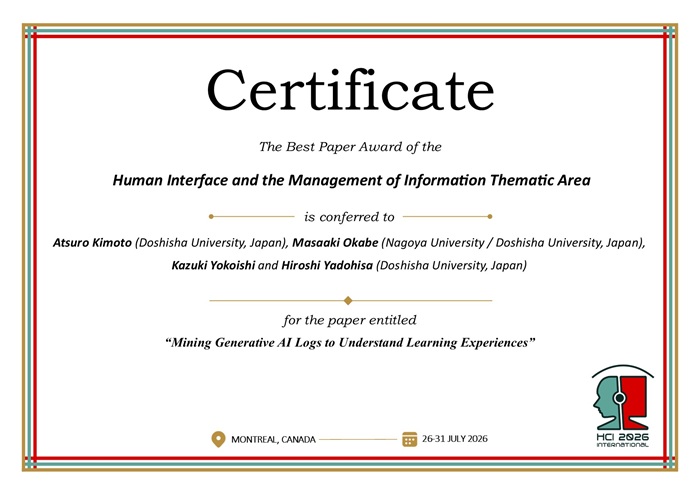
Certificate for Best Paper Award of the Human Interface and the Management of Information Thematic Area presented in the context of HCI International 2026, Montreal, Canada, 26 - 31 July 2026
Paper Abstract
The proliferation of Generative AI (GenAI) has been associated with a shift in educational paradigms from knowledge transmission to dialogue-based active learning. However, quantitatively characterizing learning-related processes in learner–GenAI interactions remains challenging. This study introduces a novel cross-disciplinary approach by applying bioinformatics trajectory inference methods to educational log analysis. Using GenAI dialogue data from 91 students in a Data Science course, we embedded prompts using Sentence-BERT, visualized interaction trajectories with PHATE, and estimated pseudotime via Slingshot as a proxy for dialogue deepening. Dynamic Time Warping (DTW) clustering revealed two distinct learner groups: a “Deepening Group” showing progressive dialogue advancement, and a “Stagnation Group” whose interactions remained superficial despite repeated exchanges. Analysis of student attributes indicated an association between cluster membership and prior domain knowledge. These findings suggest a “knowledge paradox” in AI-integrated education: effective externalization through dialogue appears to require prior internalization of domain knowledge. Our results suggest that GenAI amplifies existing knowledge rather than compensating for its absence, with implications for curriculum design that integrates knowledge acquisition with AI-supported active learning.
The full paper is available through SpringerLink, provided that you have proper access rights.