


The Best Paper Award of the 12th International Conference on Human Aspects of IT for the Aged Population
has been conferred to
Joy Lai (University of Toronto, Canada), Kelly Beaton, David Black (CCNA EPLED, Canada) and
Alex Mihailidis (University of Toronto, Canada)
for the paper entitled
"Listening before Asking: Lived-Experience Advisors as Methodological Partners in Dementia Caregiving Studies"

Joy Lai
(presenter)
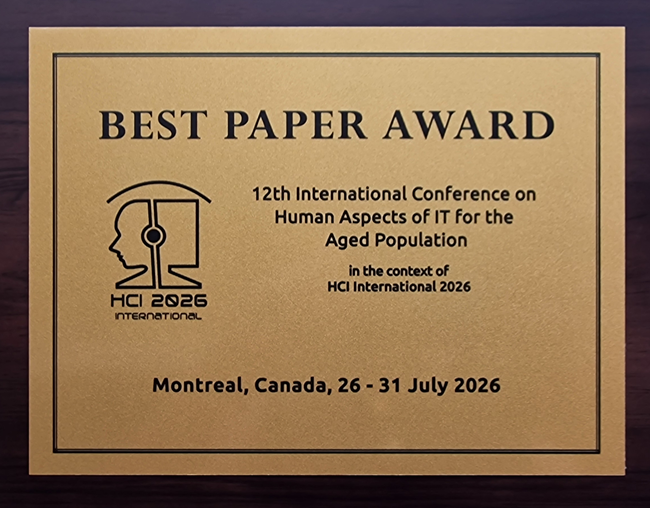
Best Paper Award for the 12th International Conference on Human Aspects of IT for the Aged Population, in the context of HCI International 2026, Montreal, Canada, 26 - 31 July 2026
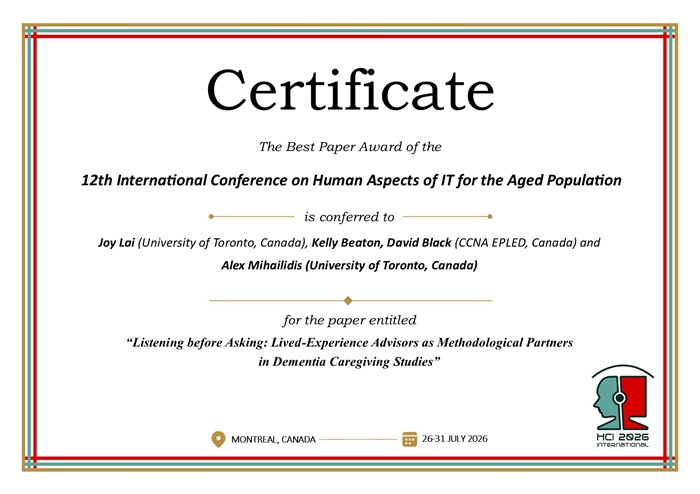
Certificate for Best Paper Award of the 12th International Conference on Human Aspects of IT for the Aged Population presented in the context of HCI International 2026, Montreal, Canada, 26 - 31 July 2026
Paper Abstract
Research with dementia caregivers poses persistent methodological and ethical challenges, particularly when interview-based studies are designed without sufficient grounding in lived caregiving realities. Questions framed through clinical or deficit-oriented assumptions risk alienating participants, undermining rapport, and producing shallow or ethically fraught data. While human-computer interaction (HCI) research increasingly adopts participatory approaches in technology design, participation rarely extends to the design of research methods themselves. This paper examines the role of lived-experience advisors as methodological partners in caregiver interview research. We report on a qualitative study in which two advisors with extensive dementia caregiving experience were engaged prior to fieldwork as methodological partners, extending participatory principles beyond technology design into the design of research methods themselves. Drawing on transcripts of advisor consultations and subsequent interviews with ten caregivers and one person living with dementia, we identify two key methodological contributions of advisor involvement. First, advisors enabled anticipatory validity by surfacing caregiving challenges, ethical sensitivities, and interpretive concerns that later appeared in caregiver interviews, allowing the researcher to enter the field with grounded awareness under constrained recruitment and fieldwork conditions. Second, advisors provided cultural, emotional, and systemic context that improved interpretive sensitivity and helped avoid misreadings. We argue that lived experience functions as methodological infrastructure, extending participatory principles into the design and conduct of research itself, and constituting a generalizable methodological pattern for HCI research with caregivers and other vulnerable or marginalized populations. This model offers a transferable approach to more ethical, rigorous, and contextually grounded HCI research with caregivers and other vulnerable populations.
The full paper is available through SpringerLink, provided that you have proper access rights.