


The Best Paper Award of the 18th International Conference on Social Computing and Social Media
has been conferred to
Mitsuhiko Fujii
(Xbrains Inc., Japan)
for the paper entitled
"Save → Plan → Impulse: A Cross-Platform Sequential Model of Short-Form Video Influence on Tourist Mobility in Car-Centric Rural Regions"

Mitsuhiko Fujii
(presenter)
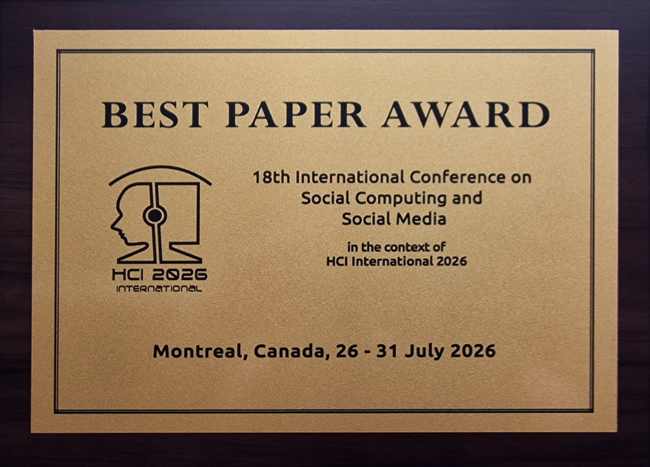
Best Paper Award for the 18th International Conference on Social Computing and Social Media, in the context of HCI International 2026, Montreal, Canada, 26 - 31 July 2026
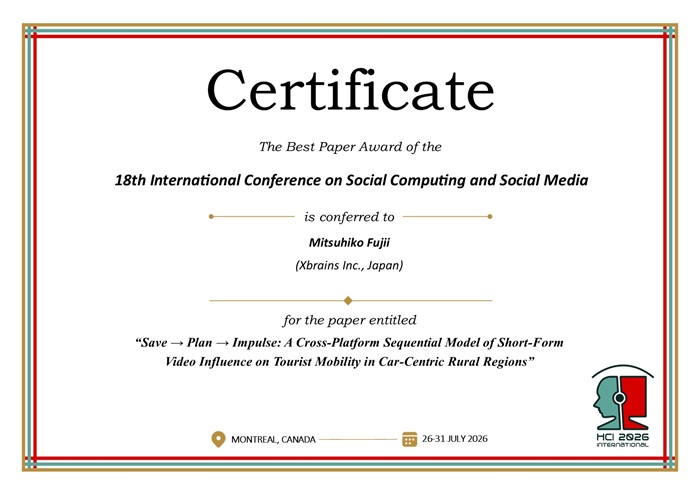
Certificate for Best Paper Award of the 18th International Conference on Social Computing and Social Media presented in the context of HCI International 2026, Montreal, Canada, 26 - 31 July 2026
Paper Abstract
Short-form videos increasingly shape tourist behavior, yet empirical evidence on how different platforms contribute to this process in rural, car-dependent destinations remains limited.
This study analyzes 468 original videos and 1,200 user comments created during a 60-day in-the-wild deployment in the Nasu region of Japan. A chi-square test revealed significant behavioral differences across Instagram, YouTube, and TikTok (χ2(4, N = 468) = 168.15, p < .001, Cramér’s V = 0.42).
Instagram predominantly elicited Save (inspiration) responses, YouTube elicited Plan (evaluation) responses, and TikTok elicited Impulse (immediate action) responses.
We describe this distributional pattern as a three-stage behavioral pathway shaped by platform affordances, rather than evidence of individual-level cross-platform transitions.
Building on these findings, we propose the concept of Kansei Resonance, a theoretical lens explaining how aesthetic micro-inputs in short videos accumulate and guide behavior across stages. The study offers an empirically grounded yet limited first step toward understanding digital influence on mobility in low-walkability rural environments, and outlines implications for future research and regional UX design.
This study provides the first large-scale, ecologically valid evidence of cross-platform behavioral segmentation in rural tourism, introducing Kansei Resonance as a novel theoretical lens with actionable implications for sensibility-driven regional UX design.
The full paper is available through SpringerLink, provided that you have proper access rights.