


The Best Paper Award of the 20th International Conference on Universal Access in Human-Computer Interaction
has been conferred to
Yujing Tang, Chao Gong, Jiayi Zhu, Ziyi Wang, Yining Xu
(Beijing Institute of Technology, P.R. China)
for the paper entitled
"Spativibe: Enhancing Directional Perception in Visually Impaired Individuals through Three-Dimensional Spatial Arrangement and Sequential Vibrations"
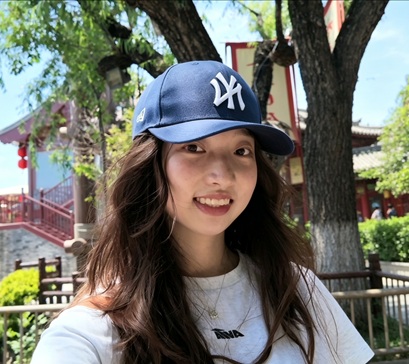
Yujing Tang
(presenter)
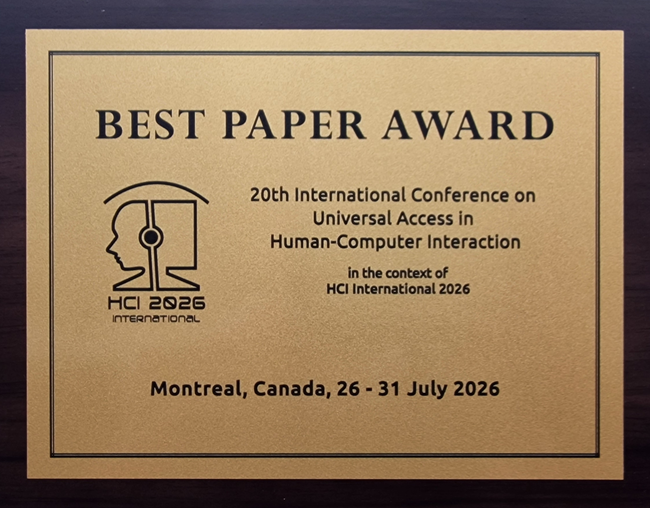
Best Paper Award for the 20th International Conference on Universal Access in Human-Computer Interaction, in the context of HCI International 2026, Montreal, Canada, 26 - 31 July 2026
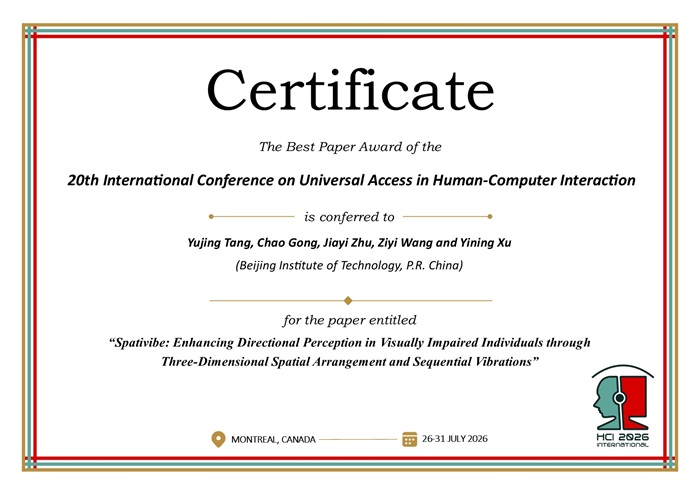
Certificate for Best Paper Award of the 20th International Conference on Universal Access in Human-Computer Interaction presented in the context of HCI International 2026, Montreal, Canada, 26 - 31 July 2026
Paper Abstract
Due to the loss of visual perception, blind and low-vision individuals (BLV) often rely on assistive navigation devices to determine direction while traveling. In the development of such devices, designers frequently employ tactile vibrations to convey directional information through touch. However, most existing studies encode information mainly through vibration frequency and amplitude. Although such parameter-based schemes can convey rich information, they typically require substantial training before users can decode the cues accurately. To address this limitation, we propose Spativibe, a sequential vibrotactile encoding method based on a three-dimensional (3D) spatial layout. Spativibe combines a 3D arrangement of vibration actuators with temporally ordered vibration patterns to establish two mappings: (1) vibration location–spatial orientation and (2) vibration sequence–directional guidance. We conducted a within-subject evaluation comparing two vibrotactile methods: Space, which uses single-line encoding based solely on a 3D spatial arrangement, and Spativibe, which uses dual-line encoding that integrates spatial arrangement and sequential patterns. Results showed that BLV participants achieved higher directional identification accuracy with Spativibe, indicating improved discriminability and accuracy of directional perception. Overall, Spativibe has the potential to enhance BLV users’ spatial orientation cognition and improve mobility experience.
The full paper is available through SpringerLink, provided that you have proper access rights.