


The Best Paper Award of the 18th International Conference on Virtual, Augmented and Mixed Reality
has been conferred to
Steffen Braun and David Blank
(Fraunhofer IAO, Germany)
for the paper entitled
"Toward a Systematic Meta-Classification of Advanced AI and XR Avatars: Bridging Technical, Social, and Ethical Dimensions for Human-Computer Interaction: LAIA²"

David Blank
(presenter)
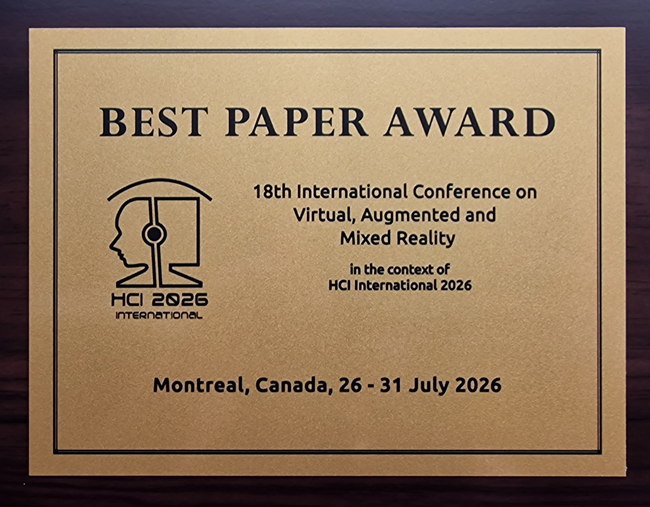
Best Paper Award for the 18th International Conference on Virtual, Augmented and Mixed Reality , in the context of HCI International 2026, Montreal, Canada, 26 - 31 July 2026
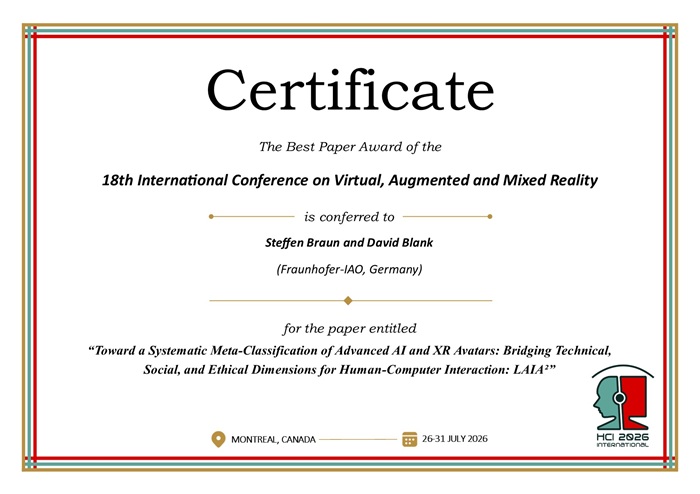
Certificate for Best Paper Award of the 18th International Conference on Virtual, Augmented and Mixed Reality presented in the context of HCI International 2026, Montreal, Canada, 26 - 31 July 2026
Paper Abstract
This study presents a unified meta-classification for AI- and XR-based avatars, synthesizing 32 core features across eight clusters: morphology, technical capability, interaction, social/emotional, contextual adaptation, and AI integration. We propose the seven-level LAIA2 (Level-based AI Avatar Assessment) maturity model (5 + 2): the first five levels capture the technical maturity of virtual actors up to today’s AVAs (Added Value Avatars), complemented by two visionary stages anticipating future developments such as multi-presence and posthuman co-evolution. A clustered heatmap reveals research hotspots in multimodal interaction and NLP, while cultural adaptation and empathy lag behind, and identifies qualitative features and research gaps to derive targeted future research priorities. This structured knowledge base supports researchers, developers, and practitioners in standardized evaluation, ethical governance, and the responsible integration of avatar technologies in complex real-world and cyber-physical environments.
The full paper is available through SpringerLink, provided that you have proper access rights.